Overview
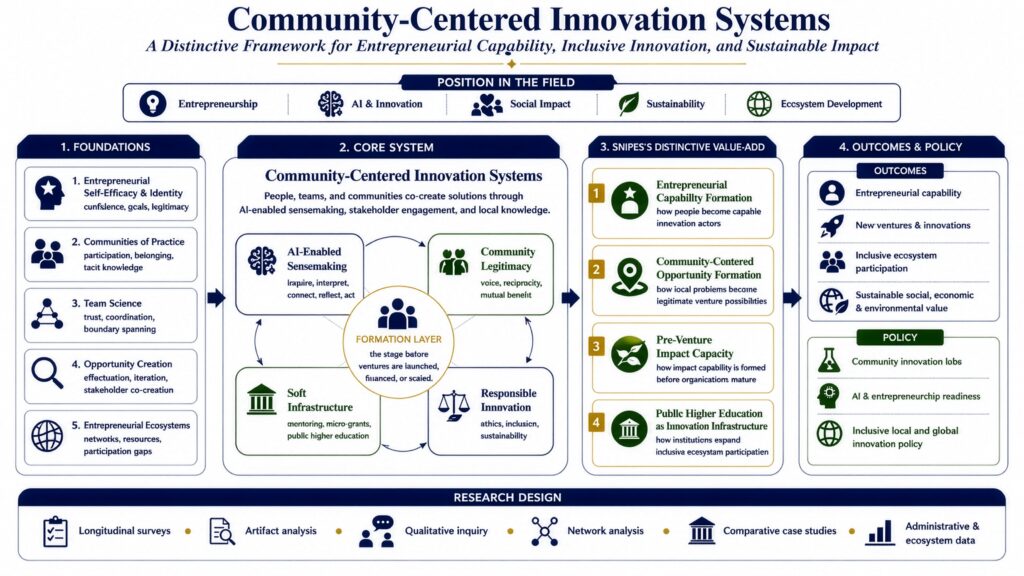
Dr. Snipes’s research examines the formation layer of innovation ecosystems: the processes through which people, teams, and communities become capable of responsible entrepreneurship before ventures are formally launched, financed, or scaled. His work theorizes community-centered innovation systems as soft infrastructure that links AI-enabled sensemaking, local inquiry, stakeholder legitimacy, micro-capital, mentoring, and sustainability-oriented problem solving. This agenda contributes to entrepreneurship, innovation ecosystem, and responsible AI scholarship by explaining how under-recognized actors enter entrepreneurial systems with capability, legitimacy, and durable pathways to social and economic value.
At the center of his research is a systems-level question:
How are entrepreneurial capability, venture legitimacy, and impact-oriented innovation formed before ventures are formally launched, financed, or scaled?
His scholarship reframes entrepreneurship education as part of the soft infrastructure of innovation ecosystems. Rather than treating learning as a classroom-based activity alone, Dr. Snipes studies how emerging entrepreneurs develop capability through community inquiry, stakeholder engagement, AI-enabled sensemaking, team-based collaboration, micro-capital, mentoring, and sustainability-oriented problem solving.
This research is grounded in the view that innovation capacity is not distributed evenly by talent or ambition alone. It is shaped by institutional conditions, access to networks, confidence, identity, community legitimacy, technological fluency, and the ability to translate local problems into viable forms of social and economic value. His work therefore focuses on the formation layer of entrepreneurship: the systems that help individuals and communities move from exclusion, uncertainty, or informal problem-solving into structured participation in innovation ecosystems.
The conceptual framework below provides the foundation for this agenda. It brings together community-centered innovation systems, AI-enabled opportunity formation, entrepreneurial self-efficacy, team science, situated learning, institutional legitimacy, civic agency, sustainability systems thinking, and the Citizen Entrepreneur Explorers Program model. Together, these traditions support a research agenda concerned with capability formation, inclusive ecosystem participation, responsible innovation, and sustainable local impact.
Research Areas
Dr. Snipes’s research agenda focuses on five linked areas:
Entrepreneurial Capability Formation
This stream examines how emerging founders and nontraditional innovators develop self-efficacy, identity, confidence, opportunity recognition, and venture readiness. It asks how individuals come to see themselves as capable innovation actors, particularly in contexts where access to entrepreneurial networks, capital, and legitimacy has been unevenly distributed.
AI-Enabled Opportunity Formation
This work studies how generative AI changes the early stages of entrepreneurship, including inquiry, interpretation, communication, business modeling, stakeholder analysis, and decision-making. Rather than treating AI as a productivity tool alone, this research examines AI as a sensemaking infrastructure that can either deepen or distort opportunity formation depending on how it is governed, contextualized, and used.
Community-Centered Innovation Systems
This area investigates how local inquiry, stakeholder voice, reciprocity, and community knowledge shape venture legitimacy and social impact. It positions community engagement not as an add-on to entrepreneurship, but as a mechanism through which opportunity claims become more grounded, accountable, and responsive to real conditions.
Soft Infrastructure for Inclusive Ecosystems
This stream examines how micro-grants, mentoring networks, team science routines, AI literacy, public higher education, and community innovation labs reduce participation gaps in entrepreneurship. It asks how institutions can build the relational and developmental infrastructure that allows more people to enter innovation ecosystems with capability, confidence, and legitimacy.
Sustainable Entrepreneurship and Systems Change
This work explores how emerging innovators use local data, sustainability tools, systems thinking, and community knowledge to develop ventures that create social, environmental, and economic value. It connects entrepreneurship to broader questions of resilience, climate adaptation, workforce development, and place-based economic transformation.